
What is the difference between hard law and soft law? How can we identify soft norms? These issues occupied lawyers in cases T-721/14 and C-16/16P Belgium v Commission where the delineation of a recommendation from directives was at stake. In its final judgment, the CJEU declared that even in cases of recommendations that mimic directives in many ways, it is the content, context, intention and wording of the norm, that determines whether it is in fact a binding, or a soft law, act. In our paper, we focused on the wording element of the CJEU’s test and tried to discern differences between the wording of directives and directive-like recommendations to see whether this method of delineation actually holds water.
Our research departed from the above-mentioned judgement where the General Court held, and subsequently the Court confirmed that there is a special genre of recommendations – that we refer to as directive-like recommendations. These acts mimic the traits of directives, including a clause on implementation, an implementation deadline and provisions on Member State reporting and are in fact soft norms. The CJEU concluded that recommendations and hard law acts can be distinguished by relying on an analysis of, among others, the wording of the norm under scrutiny. According to the first step of the test proposed by the CJEU, the nature of the norm’s wording should be analysed: hard norms are characterized by mandatory wording, while non-binding norms will exhibit a preponderance of hortatory wording. The interpreter’s impression of soft or hard wording should, in a second step, be confirmed by way of an inter-lingual comparison of the different language versions of the same norm: if other language versions also allow for the same conclusion, then the impression should be correct.
Concentrating on the wording part of the CJEU’s test, we were interested to find out if there are any ‘verbal markers’ of softness that may actually be discerned even in the ‘hard cases’ of directive-like recommendations that share several similarities with the hard law directive. To put the CJEU criteria to the test, we built two small corpora of directives and directive-like recommendations in English, German and Spanish. Both corpora include norms adopted by the Commission in the same period. Next, we applied computer-based analysis to our corpora individually, to glean the individual corpora’s characteristic terms. Our assumption was that directive-like recommendations shall carry more hortatory terms, while directives will be worded in a more compulsory language.
In our analysis we were very aware that legal texts are written to speak to human persons and not formulated for machines. Indeed, as we built a simply clustering model, our analysis is far from claiming that our model could ‘understand’ the texts we fed it with. So, as to make out results as much as possible independent of the artefacts of the specific way that computers would process the texts in difference to humans, we simply built the corpora two times, a lemmatized version (i.e. a version where all words are cut to the same stem, such as ‘improve’, ‘improving’ and ‘improved’ all being cut to ‘improv’) and a non-lemmatized version.
To arrive at meaningful results, we cleaned the corpora of stopwords (such as ‘and’ or ‘the’, having merely grammatical function), including references to the terms ‘directive’ or ‘recommendation’ (as otherwise the result would have been that the two kinds of acts can be distinguished by their title – a true but trivial result). The resulting texts were analysed using the sklearn, a standard machine learning package in python. The analysis tests for the frequency of a word in the different corpora, recommendations and directives, respectively, allowing for inferences on the type of act as a verbal marker.
Our analysis clearly showed that verbal markers in directive-like recommendations are more hortatory in nature (‘invited’ and ‘encourage’) than those gleaned from directive (‘shall’, ‘states shall’, ‘states shall ensure’, ‘shall take’, ‘shall also’, ‘shall apply’ and ‘shall communicate’). Similar results emerged in respect of the German and the Spanish corpora’s analysis.
A more interesting issue is that the verbal markers of the different corpora in the analysed languages are different. For example, while the German directive-like recommendations’ and directives’ verbal markers both refer to Member States equally, it is only the directives in Spanish that exhibit this verbal marker. Another variation between the results in the different language versions is that the English language versions’ verbal markers typically feature more verbs than their Spanish and German counterparts.
Our research showed, that in fact, there are verbal markers characteristic of directive-like recommendations on the one hand, and directives on the other, which may be useful for discerning the nature of the act under scrutiny. However, even though the corpora consisted of the same directive-like recommendations and directives in their English, German and Spanish language versions, owing to the grammatical differences between these languages (e.g. implicit subject, passive voice etc.), results of the computer-based analysis will vary, leading to different verbal markers. As such, there are no cross-cutting, general rules characteristic of soft directive-like recommendations and hard directives in every language version. Instead, the verbal markers identified and the characteristics are only useful for intra-lingual analysis.[1]
—
Posted by Petra Lea Láncos (Full professor, Péter Pázmány Catholic University, Faculty of Law and Political Sciences; lancos.petra.lea[@]jak.ppke.hu) & Eljalill Tauschinsky (PhD Amsterdam, Privacy Manager at BD GmbH).
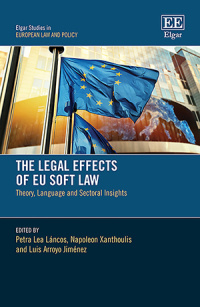
This blog piece is based on a chapter by P Láncos and E Tauschinsky, “Verbal markers of ‘softness’ in EU law? A computer-based analysis to delimit soft law and hard law focusing on directive-like recommendations”, in P Láncos, L Arroyo and X Xanthoulis (eds) The Legal Effects of EU Soft Law, Theory, Language and Sectoral Insights. Edward Elgar 2023, p. 111.
Suggested citation: Petra Lea Láncos & Eljalill Tauschinsky, “Is there such a thing as soft wording?”, REALaw.blog, available at https://realaw.blog/?p=2875
[1] Since the number of acts included in the corpora was low, achieving accurate results through computer-based analysis was a challenge. To consolidate the results achieved, the analysis should be conducted with greater sample sizes. The detailed description of the computer-based analysis, the acts included in the corpora and the tables on the resulting the verbal markers in English, German and Spanish are included in the published chapter.
 REALaw.blog